Guide
GE Monogram Water Dispenser Not Working: Let the Ice Maker Split the Fault
Whether the ice maker is still producing is the most useful thing you know about a dead water dispenser. It divides the fault into an upstream half and a downstream half before you touch the filter, and only one of those halves is homeowner work.
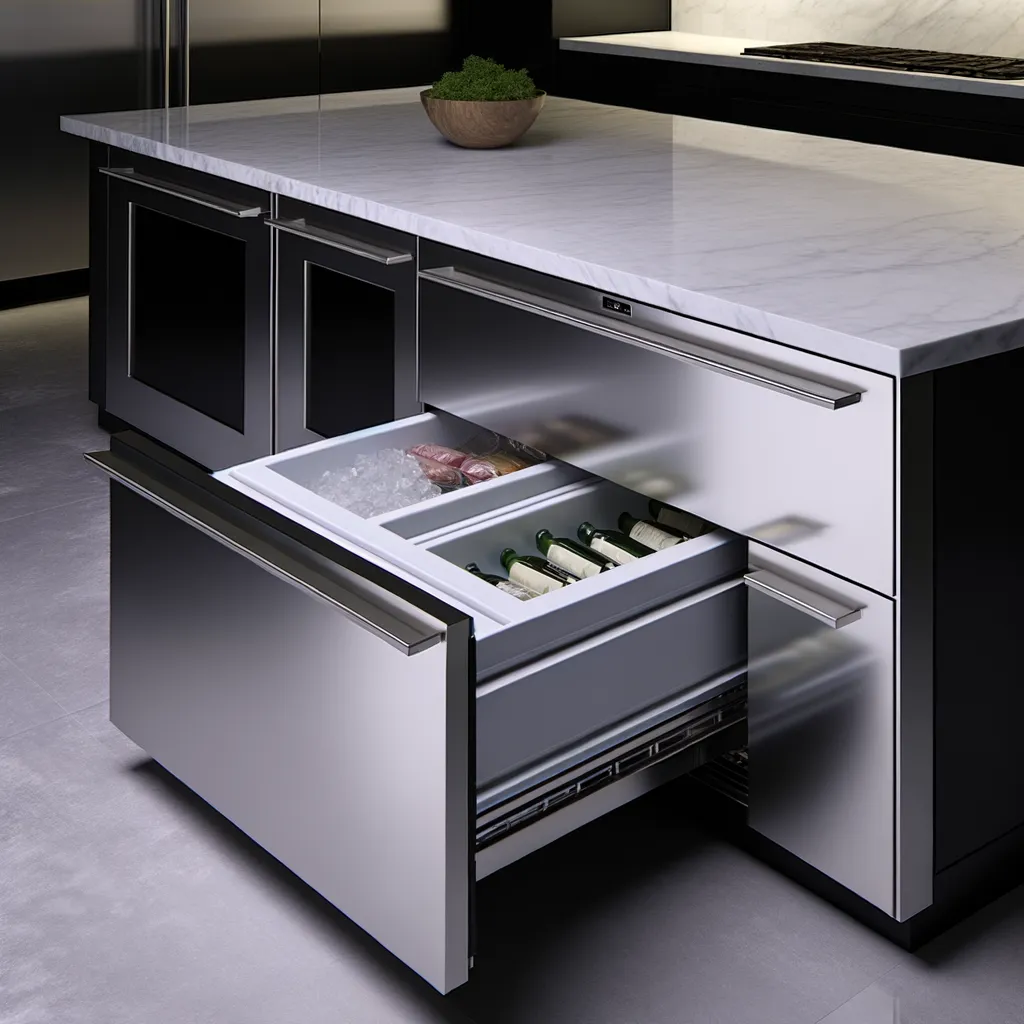
Before you change a filter or pull the unit out, answer one question: is the ice maker still making ice? If it is, water is reaching the appliance and passing through the filter perfectly well, and the fault is downstream — a dispenser solenoid, a frozen line in the door, a switch, or a control lock nobody remembers pressing. If ice has stopped too, the fault is upstream of the fill valve, in the supply, the stop or the cartridge. That single question eliminates roughly half of the possible causes in about ten seconds, and almost nobody asks it first.
Why the split works
A built-in refrigerator takes one water supply and divides it inside the machine. It arrives at an inlet valve that carries more than one solenoid: one path opens to fill the ice mould, another feeds the dispenser circuit. Downstream of that split the two systems have almost nothing in common — the ice path goes to the mould, the dispenser path goes through a chilling reservoir and up into the door.
So a failure that affects both has to sit before the split. A failure that affects only one has to sit after it. That is the entire logic, and it holds regardless of which generation of Monogram you have.
Say the ice is fine and the water is dead: nobody needs to look at the house stop valve, the saddle fitting or the cartridge, because ice production has already proved all three are working.
Upstream: everything before the fill valve
If both have stopped, work outward from the appliance.
Find the stop that feeds the unit — usually under the sink, in a basement below the kitchen, or behind an access panel — and confirm it is fully open rather than nearly open. A quarter-turn valve knocked part way during unrelated plumbing work leaves a feed that is technically connected and practically starved, which is the state most likely to be mistaken for a failed component inside the appliance. If the feed is an old saddle fitting clamped onto a copper line, treat it with suspicion; they clog at the piercing point and they were never intended to be permanent.
Then the filter. The reliable test is not inspection, it is substitution: fit a new cartridge, or fit the bypass plug if your model takes one, and see whether flow returns. Recovery on bypass tells you something real about restriction. It is a diagnostic step rather than a way to live, since bypass means unfiltered water to both the glass and the ice.
Aftermarket cartridges complicate this. A copy may lock into the head cleanly, sit flush, and still meter a slower stream than the part it replaced, and what you see at the dispenser then looks identical to a failing valve.
Last upstream item, and the one people find by accident: the tubing behind the cabinet. A built-in pushed home against a soft copper tail or a plastic line with too tight a bend will restrict it permanently. In the older Belmont two-families and the tighter Arlington Heights kitchens that run disappears into a gap with barely any clearance, and it has been asked to turn more sharply than it should.
Downstream: the door, the reservoir and the frozen tube
Ice fine, water dead. Now the interesting half.
The most common cause by a distance is a frozen line. The dispenser’s water sits in a reservoir inside the fresh-food compartment so it comes out cold, and a tube carries it from there up through the hinge area and into the door. If the fresh-food compartment is running colder than it should — set too low, or genuinely colder than the display claims — the water standing in that tube can freeze. The classic signature is a dispenser that gives you a short spurt and then nothing, and gives you the same short spurt every time, because you are getting the small volume in the door and no more.
Setting the fresh-food compartment to something around the high thirties Fahrenheit and giving it several hours is a legitimate first move. If dispensing recovers, you have found it, and the question becomes why the compartment was that cold in the first place.
The other downstream candidates are the dispenser’s own solenoid on the fill valve, which fails independently of the ice solenoid on the same valve, and the paddle or switch behind the dispenser recess. A switch that has been pressed thousands of times with a glass gets sticky, and a paddle with grit in its pivot may look like it moves while never quite closing the contact.
The cases where nothing is broken at all
Two of these turn up often enough to check before anything else.
A dispenser lock or control lock, usually held for a few seconds on the panel to set, disables the dispenser while leaving lights and displays looking entirely normal. Households with children set it deliberately and then forget it exists.
And the door switch. The dispenser is inhibited while the appliance believes the door is open, so a switch that has stuck or a door not quite pulling flat against its seal can produce a dispenser that refuses to work and an interior light that stays on. If the light in the compartment does not go out when the door closes, you have found something.
Where this stops being a homeowner job
Stop at three findings. Water on the floor or a damp line behind the cabinet is a leak, and a leak behind a built-in reaches subfloor and cabinetry long before it reaches anywhere visible. A compartment no longer holding temperature outranks the dispenser entirely and is the real call. And anything requiring the unit to be drawn out of its joinery on a floor you care about is not worth the risk of a scratch.
The honest scope note: this bench works on Sub-Zero built-in refrigeration and does not take GE Monogram service. The mechanisms above are common to built-in refrigeration generally, which is why the note is worth writing, but the model-specific parts, the diagnostics and the fit-out are Monogram’s own and belong with somebody who works on them. If the appliance in question is a Sub-Zero, ice maker and water plumbing is a standing part of the work here, the visit is a flat $95 credited against the repair, and either the phone number or the booking link above will start it.
Still asked on the phone
How long should it take for water to appear after a filter change?
A few seconds of nothing, then spitting, then a steady flow. The air that entered the housing while the cartridge was out has to be pushed through, and until it is you get bursts and cloudy water that clears in the glass. If the flow has still not settled after running several glasses through, the problem is not air — look at whether the cartridge seated fully and whether it is a fit the housing was designed for.
Can a dispenser fail from a filter that is simply too old?
It can, and it is the most common preventable version of this fault. Restriction arrives long before any change in taste does, which is why nobody sees it coming — the drinking water is fine right up to the point where the glass takes twice as long to fill. Slow water arriving in the same month as visibly smaller ice cubes is that pattern nearly every time, because both circuits are being throttled by the same cartridge.
The water tastes fine but comes out warm. Is that the same fault?
No, and it points somewhere different. Dispensed water is chilled by a reservoir sitting inside the fresh-food compartment, so warm water with normal flow means either the reservoir is being drawn faster than it can recover — normal after several glasses in a row — or the compartment itself is not as cold as the display claims. If the second is true, the dispenser is the symptom and the refrigeration is the fault.